

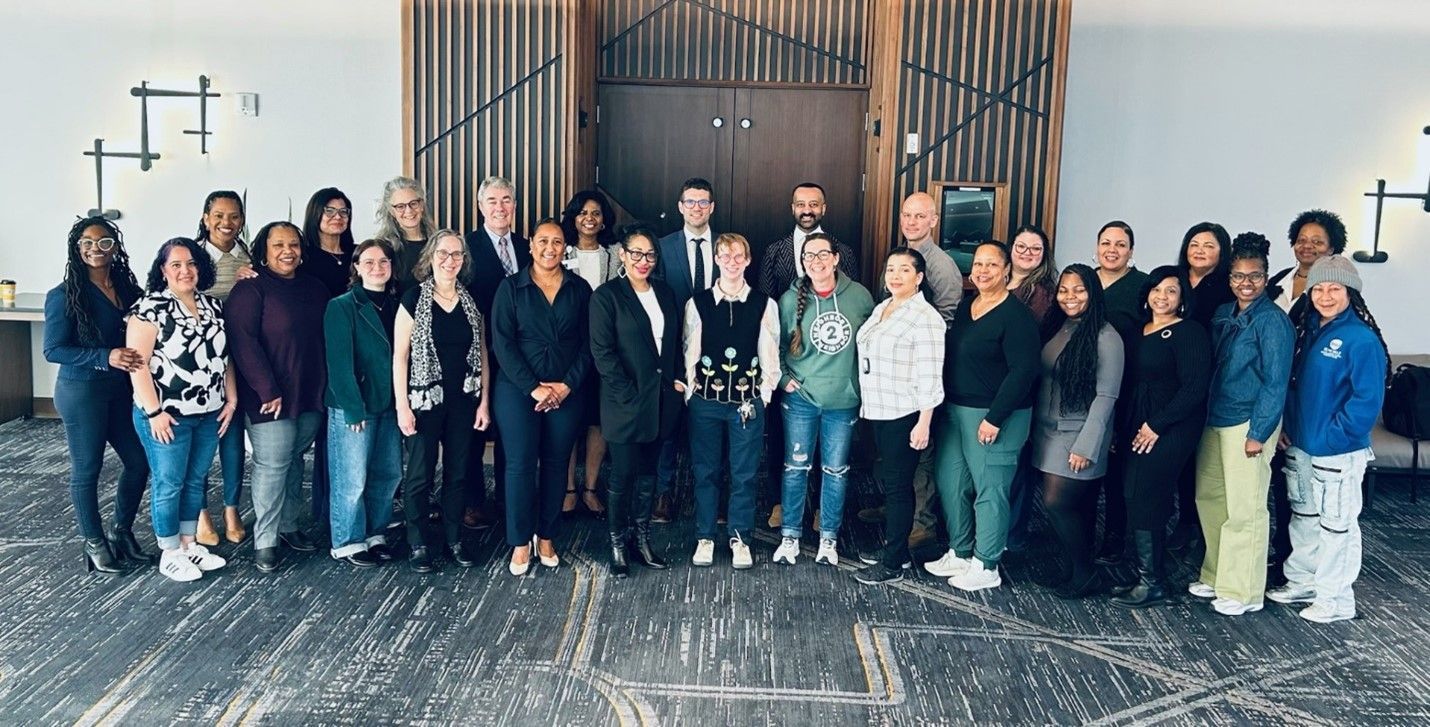
This month, Live Well Springfield Coalition proudly served as the host site for the National Transforming Communities Initiative (TCI) Learning Institute at the Marriott Hotels and Conference Center in Downtown Springfield. The event brought together grantees from nine awarded sites across the country, with participants traveling from as far as Illinois, California, and Michigan.
Led by our national Trinity Health partners, Jaime Dircksen, Vice President of Community Health and Well-Being, and Beth Geno-Otto, Manager of Operations & Community Initiatives, the conference provided a dynamic peer-learning environment. Grantees shared best practices and strategies for addressing community-based challenges through a policy, systems, and environmental change framework, fostering collaboration and knowledge exchange across sites.
Across the nine sites, grantees are tackling critical issues such as housing, food security, neighborhood safety, and mental health. These focus areas were identified through an inclusive, community-driven process following a review of each hospital’s Community Health Needs Assessment and additional local assessments conducted over the past two years.
During the three-day conference, attendees were welcomed by Jessica Collins, Executive Director of the Public Health Institute of Western Massachusetts (PHIWM), along with Robert Roose, President of Mercy Medical Center in Springfield, Johnson Memorial Hospital in Stafford, CT, and Saint Mary’s Hospital in Waterbury, CT. Dan Keenan, Vice President of Government Relations for Trinity Health of New England, also provided remarks.
Additional special guests included PHIWM Board President Luz Lopez, Board Chair Dr. Edna Rodriguez, and Valerie L. Powell-Stafford, President of Saint Francis Hospital and Syed A. Hussain, MD Chief Clinical Officer.
As part of the conference, grantees participated in three community tours across Hartford, Springfield, and Holyoke, each focused on key issues: housing, food access, and mental health. These tours were coordinated by local community sites with support from grassroots organizations working within their respective coalitions.
Highlights from the tours included:
- A visit to Wellspring Harvest Greenhouse, where Trinity Health’s initial investment through the first round of TCI funding helped provide low-interest loans to support community development.
- A stop at Gardening the Community and Farm Store, where youth leaders discussed urban agriculture and preparations for the spring planting season.
- A thought-provoking conversation on housing development led by Keith Fairey, CEO and President of Way Finders.
We extend our deepest gratitude to the many organizations that welcomed grantees and shared both the challenges and successes of their work, including Arise for Social Justice, Neighbor 2 Neighbor, Gardening the Community, Wellspring Harvest Cooperative, the Food Bank of Western Massachusetts, Revitalize CDC, and Way Finders.
Our community partners showcased their dedication to creating safe, sustainable housing, advocating for tenant rights, and ensuring that families have access to healthy homes and thriving neighborhoods. Their work uplifts communities, allowing residents to live in safe, stable environments where they can grow and thrive.
As the conference came to a close, Jaime Dircksen shared her heartfelt gratitude and underscored the importance of continuing this work, despite the challenges posed by the current political climate. Trinity Health remains steadfast in its commitment to investing in the nine sites throughout the remaining three years of this five-year grant.
Together, we will continue building healthier, stronger communities through collective action and shared vision.
SHARE